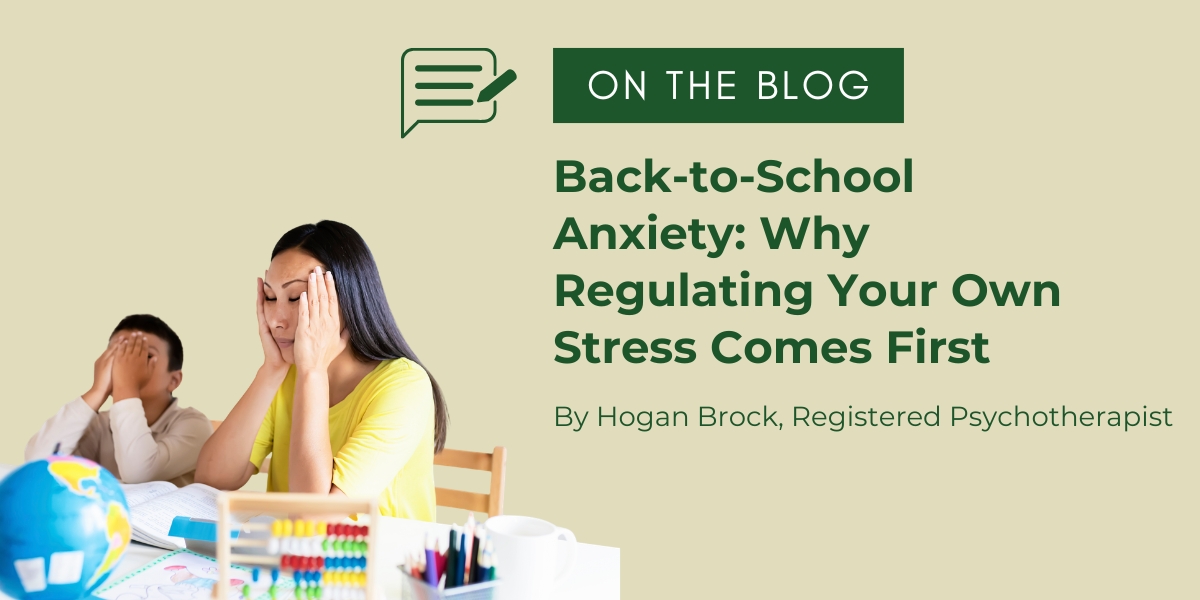
The backpacks are out. The school supply lists are printed. And somewhere between the new-shoe shopping and the first-day photos, a lot of parents feel a familiar knot in their stomach.
We talk about back-to-school season like it’s a transition for kids. New teacher. New routine. New social dynamics to figure out. But it’s a transition for parents too. And how we manage our own nervous system during this time matters more than most of us realize.
I’m a psychotherapist. I work closely with emotional regulation. And every September, I see the same pattern. Parents pour everything into preparing their kids for change. And quietly, they run on empty themselves.
This post is about closing that gap.
Why Your Regulation Matters More Than You Think
Kids don’t come with a fully built-in ability to manage big feelings. Not yet. Especially the younger ones. They borrow our nervous systems. That’s what co-regulation means. Kids read the room. They look to the calm — or the lack of it — in the adults around them, and they decide how safe things are.
If you’re anxious about drop-off, your child will likely feel that before you say a single word.
This doesn’t mean you need to be calm all the time. Nobody is. It means your own awareness becomes one of the most useful tools you carry into this season.
The Back-to-School Mirror
You may notice your child seems clingier. More irritable. Quicker to tears. Even when nothing has outwardly happened to them.
Often, something is happening. It’s just happening to you. New schedules. New drop-off logistics. Work deadlines and the ramp-up of summer ending. Your own worry about how the year will go. Kids feel that undercurrent, even when we think we’ve hidden it well.
The goal isn’t to get rid of the stress. That’s not realistic. Not for any family. The goal is to notice it. Name it. Respond to it on purpose, instead of letting it spill over into how you show up for your kids.
Practical Ways to Build Your Own Regulation Skills
Regulation is a skill. Not a personality trait. Which means it can be practiced. Here’s where to start.
- Name it before you manage it. A quiet check-in, “I’m noticing I feel tense about this morning,” creates a pause that is small, but enough.
- Separate your anxiety from your child’s experience. Your worry about the first day is real. It doesn’t mean something is wrong for your child. Ask yourself: is this feeling mine, theirs, or both?
- Build in a physical reset. A few slow breaths. A short walk. Unclenching your shoulders before pickup. Small things. They shift your body out of a stress response, and that changes the tone you bring into the room.
- Protect a few minutes of your own routine. Five quiet minutes with your coffee before the rush starts gives your nervous system a chance to settle.
- Model repair, not perfection. If you snap, if you seem stressed, say so afterward. “I was feeling rushed this morning. That wasn’t about you.” Kids learn that regulation includes recovery. Not just staying calm.
Notice When You’re Carrying More Than Yours to Carry
Here’s a pattern I see a lot. Parents taking on emotional weight that isn’t theirs. Over-functioning for a child’s feelings. Trying to prevent every hard moment. Absorbing a child’s distress like it’s their own.
It comes from love. It always does. But it wears parents down. And over time, it can make it harder for kids to build their own coping skills.
Supporting your child through a transition doesn’t mean shielding them from every uncomfortable feeling. It means staying steady enough that they learn something important: discomfort is survivable. And they have their own capacity to move through it.
A Quick Reset You Can Use This Week
Next time the tension rises, try this. Pause. Take three slow breaths. Name what you’re feeling, in one sentence. Then ask whose feeling it actually is.
Just a small practice, repeated week over week. That’s what builds the kind of regulation that supports you (and your child!) through this transition.
Ready for More Support This School Year?
If this season is bringing up more than a season’s worth of stress, therapy can help. You can build lasting tools for emotional regulation — for yourself, and in how you show up for your family. Book a consultation to talk through what that could look like for you this year. I can help you work towards emotional regulation. And in knowing where your responsibility ends and your child’s begins.
Book a discovery call or initial consultation with Hogan to learn more.
Hogan Brock, Registered Psychotherapist
Sage Naturopathic Clinic
Sources
Brown University Health. “Five Tips to Manage Back-to-School Anxiety (Parents’ That Is!).” Brown University Health (blog). Accessed July 28, 2026.
https://www.brownhealth.org/be-well/five-tips-manage-back-school-anxiety-parents.
Child Mind Institute. “What Is Co-Regulation?” Child Mind Institute. Last modified May 22, 2026. https://childmind.org/article/what-is-co-regulation/.
National Institute for Children’s Health Quality. “Children’s Social and Emotional Development Starts with Co-Regulation.” NICHQ, May 1, 2025.
https://nichq.org/blog/childrens-social-and-emotional-development-starts-co-regulation/.
Center on the Developing Child. “Serve and Return: Back-and-Forth Exchanges.” Harvard University. Accessed July 28, 2026. https://developingchild.harvard.edu/key-concept/serve-and-return/.
Zimmer-Gembeck, Melanie J., Julia Rudolph, Jessica Kerin, and Gal Bohadana-Brown. “Parent Emotional Regulation: A Meta-Analytic Review of Its Association with Parenting and Child Adjustment.” International Journal of Behavioral Development 46, no. 1 (2022): 63–82. https://doi.org/10.1177/01650254211051086.